How to Identify & Correct Commonly Confused Words in Writing: A Worksheet Guide
1. Affect vs. Effect:
Affect (as a verb): to have an influence on.
Example: The weather affects our moods.
[toc]
Effect (as a noun): the result of a change that has been made.
Example: The effect of the storm was devastating.
2. Accept vs. Except:
Accept (as a verb): to receive or agree to something.
Example: She accepted the gift with gratitude.
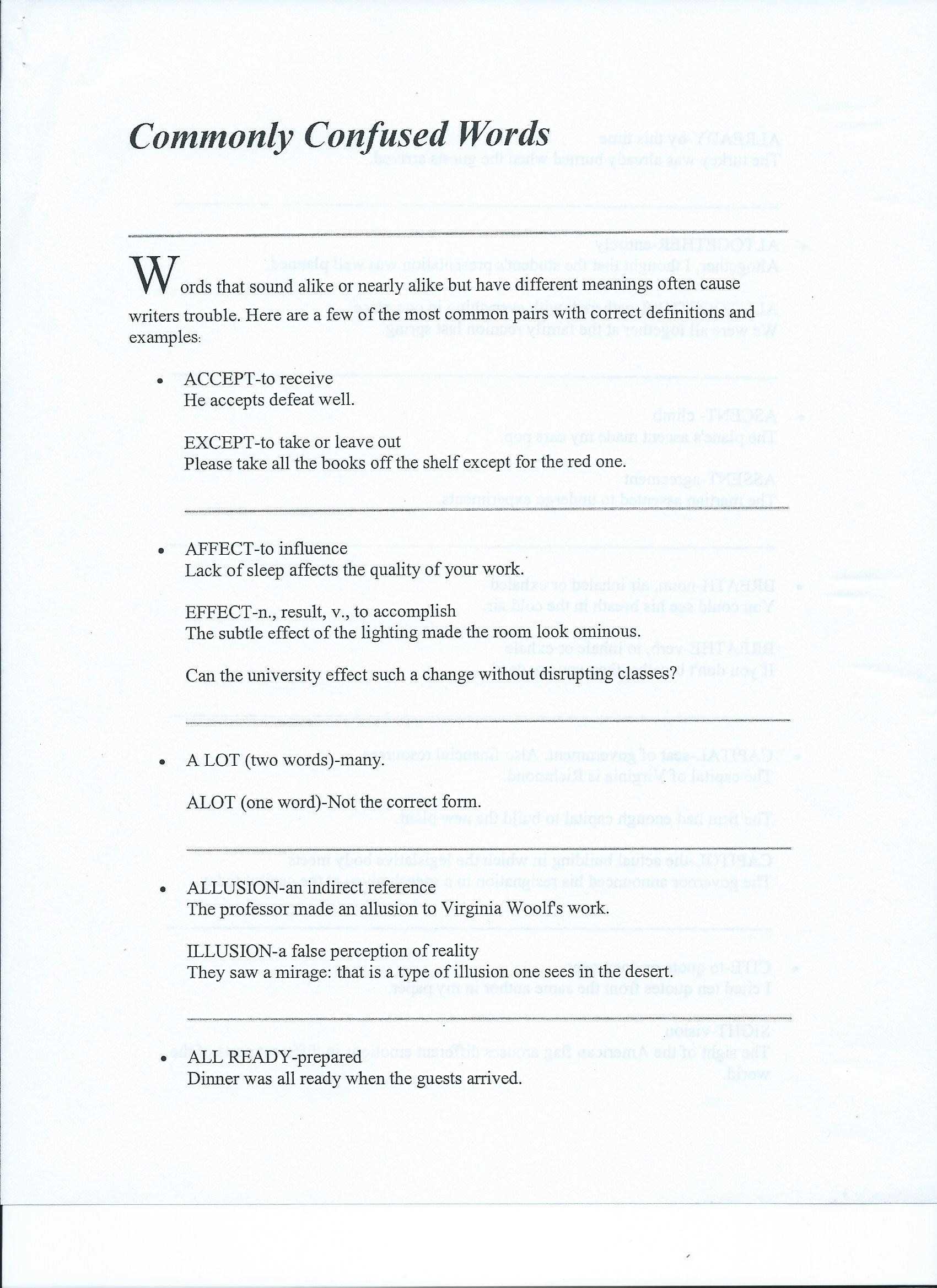
Except (as a preposition): to exclude something.
Example: Everyone was invited to the party except for him.
3. Advice vs. Advise:
Advice (as a noun): a suggestion or recommendation.
Example: His advice was invaluable in making my decision.
Advise (as a verb): to give advice or a recommendation.
Example: He advised me to take the job.
4. Beside vs. Besides:
Beside (as a preposition): at the side of.
Example: She sat beside him on the bench.
Besides (as an adverb): in addition to.
Example: Besides the food, there was also music at the party.
5. Compliment vs. Complement:
Compliment (as a noun): an expression of praise or admiration.
Example: He gave her a compliment on her dress.
Complement (as a noun): something that adds to or completes another thing.
Example: The wine was a perfect complement to the meal.
Tips for Understanding & Avoiding Commonly Confused Word Pairs: A Worksheet Tutorial
Introduction
English is a notoriously difficult language to learn, and one of the most common sources of confusion are words that sound similar or have similar spellings, but have different meanings. These commonly confused word pairs can confuse even native speakers, making it difficult to write clearly. This tutorial will provide helpful tips for understanding and avoiding commonly confused word pairs, and provide an accompanying worksheet to help you practice.
Tips for Understanding & Avoiding Commonly Confused Word Pairs
1. Familiarize yourself with the most common confused word pairs. The more you know, the easier it will be to remember the correct usage.
2. Pay attention to context clues. If you’re not sure which word to use, look at the surrounding words and sentences to determine the correct choice.
3. Use a dictionary if you can’t determine the correct usage. A dictionary will provide definitions and examples of how to properly use the words in context.
4. Practice, practice, practice. The more you use the words in context, the easier it will be to remember and use them correctly.
Worksheet
Instructions: For each word pair, determine which word should be used in the sentence and then rewrite the sentence using the correct word.
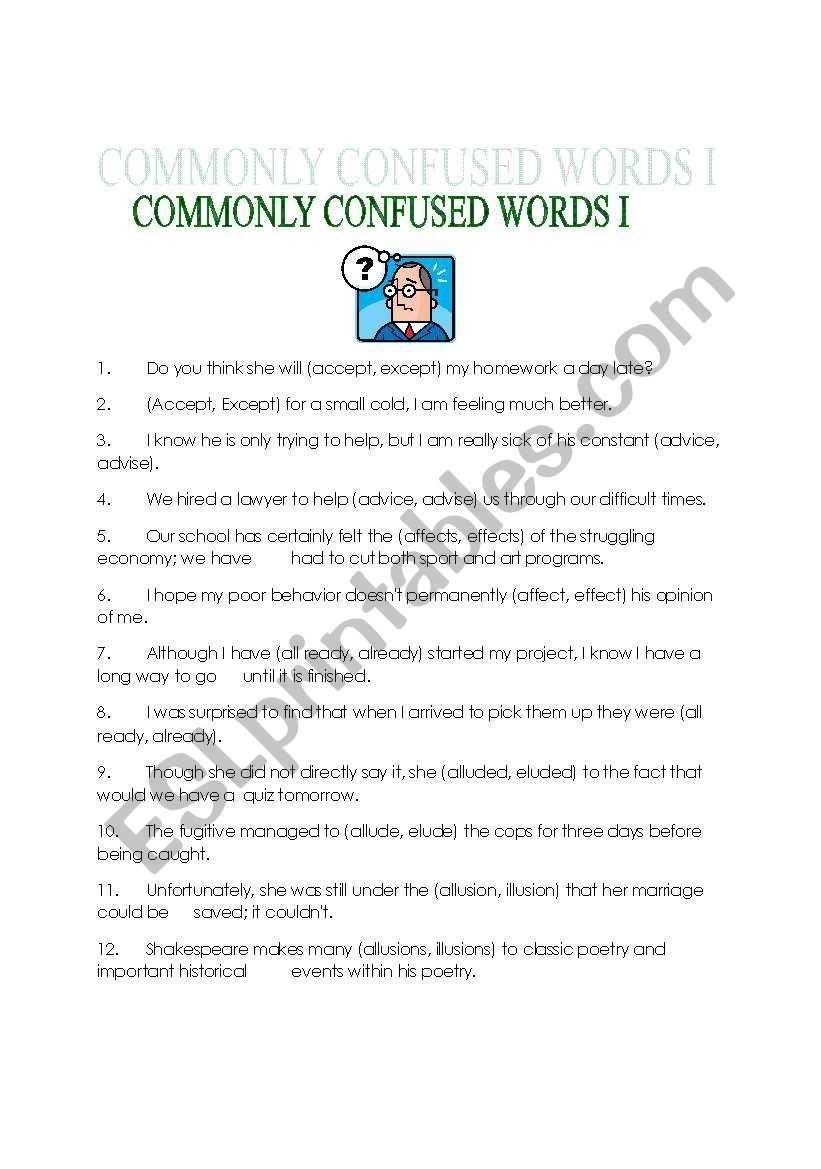
1. accept/except
I _____ the invitation to the party.
Answer: accepted
I accepted the invitation to the party.
2. affect/effect
The new policy had a significant _____ on employee morale.
Answer: effect
The new policy had a significant effect on employee morale.
3. principal/principle
The _____ of honesty is an important value.
Answer: principle
The principle of honesty is an important value.
4. advice/advise
I would _____ you to think carefully before making a decision.
Answer: advise
I would advise you to think carefully before making a decision.
Conclusion
By following the tips and completing the accompanying worksheet, you should be better equipped to understand and avoid commonly confused word pairs. With practice, you will become more confident in your writing and be able to communicate your ideas more clearly.
How to Utilize a Commonly Confused Words Worksheet to Improve Writing Clarity
Utilizing a commonly confused words worksheet is a valuable tool for improving writing clarity. A commonly confused words worksheet will typically provide a comprehensive list of words that are often confused in writing, with the correct term and definition provided. This list can then be used to identify words that may be misused in a given piece of writing. When reviewing a piece of writing, a person can use the list to look for any words which may be misused and ensure that they are replaced with the correct term.
Additionally, a commonly confused words worksheet can be used to prevent the misuse of words in the first place. This can be done by having the writer review the list of commonly confused words before beginning their writing task. This can help them to become more familiar with the correct terms and ensure that they are using them properly.
Furthermore, a commonly confused words worksheet can be used to deepen a writer’s understanding of words. By looking at the definitions provided in the list, a writer can gain a better understanding of the nuances between similar words. This can help them to use words more accurately, with greater precision and clarity.
In conclusion, a commonly confused words worksheet can be an invaluable tool for improving the clarity of writing. It can be used to identify and replace misused words, to prevent the misuse of words in the first place, and to deepen a writer’s understanding of words. Utilizing this tool correctly is a surefire way to improve writing clarity.
How to Create & Use a Customized Commonly Confused Words Worksheet for Classroom Learning
Creating and using a customized commonly confused words worksheet for classroom learning can provide a tangible resource for students to refer to and reinforce their understanding of grammar and language rules. Utilizing this tool can help students increase their mastery of commonly confused words and become more confident in their writing. Here are the steps for creating and using a customized commonly confused words worksheet for classroom learning.
Step 1: Research and Collect Commonly Confused Words
The first step in creating a customized commonly confused words worksheet is to research and collect the words that are commonly confused. This can be done by researching online, consulting books, and speaking to other teachers. Once the list of words has been compiled, the next step is to make sure the list is organized in a logical order that students can easily understand.
Step 2: Create the Worksheet
Once the list of words is organized, the next step is to create the worksheet. This can be done in a word processing program such as Microsoft Word, or in a spreadsheet program such as Microsoft Excel. The worksheet should include a column for each word, and a column for the definition or explanation of the word. It should also include an example sentence using the word correctly.
Step 3: Educate Students on the Worksheet
Once the worksheet has been created, the next step is to educate the students on the worksheet. This can be done by providing a brief explanation of commonly confused words, as well as a review of the worksheet and the words included on it. It is important to make sure the students understand the purpose of the worksheet and how they can use it to improve their understanding of grammar and writing.
Step 4: Use the Worksheet in the Classroom
The last step is to use the worksheet in the classroom. This can be done by providing students with an opportunity to practice using the words on the worksheet in sentences and discussions. This can also be done by providing students with writing assignments that require the use of commonly confused words. Additionally, the worksheet can be used as a review tool before tests and quizzes.
By creating and using a customized commonly confused words worksheet, students can become more confident in their writing and have a tangible resource to reference when needed. This can help them to increase their mastery of commonly confused words and improve their understanding of grammar and language rules.
Crafting a Comprehensive List of Commonly Confused Words: A Worksheet Exercise
Creating a comprehensive list of commonly confused words can be a daunting task. It requires knowledge of English grammar and an understanding of how different words are used. To help you get started, this worksheet will provide you with a step-by-step guide to crafting a comprehensive list of commonly confused words.
Step 1: Select a source. Start by selecting a source that provides a list of commonly confused words. This could be a book, a website, or an online resource. Make sure the source you select has accurate and up-to-date information.
Step 2: Identify the pairs of words. Once you have selected a source, begin to identify the pairs of words that are commonly confused. Make sure to include the definitions of each word so you can easily distinguish between them.
Step 3: Research their uses. After you have identified the pairs of words, begin to research how they are used in different contexts. This will allow you to determine which word is more appropriate for a particular situation.
Step 4: Categorize the words. Once you have researched the words, begin to categorize them. Try to group them according to the contexts in which they are used. This will make it easier to distinguish between them.
Step 5: Create a list. Finally, create the list of commonly confused words. Make sure to include all the words you have identified and the definitions of each word. This will help you remember which word is more suitable in a particular context.
By following these steps, you can craft a comprehensive list of commonly confused words. This list can be used as a reference when you are writing or speaking. It will also help you to avoid making mistakes when using words in different contexts.
Strategies for Mastering Commonly Confused Words with a Worksheet Activity
Mastering commonly confused words can be a difficult task for many individuals. However, with the use of a worksheet activity, individuals can practice and hone their skills in order to properly identify and use these words.
To begin, individuals should select a list of commonly confused words. This list should include words that are similar in meaning and/or spelling, such as “affect” and “effect” or “there” and “their.” Once the list is chosen, the individual should create a worksheet containing the words and their definitions.
Next, the individual should create several sentences using the words in the list. The sentences should be creative and engaging to ensure the individual stays interested in the task. It may also be helpful to create sentences using different parts of speech, such as verbs, nouns, and adjectives.
Once the sentences are created, the individual should complete the worksheet by writing each sentence and then choosing the correct word to fill in the blank. This will help ensure that the individual is familiar with the different meanings of the words and can correctly identify when to use each one.
Finally, the individual should review the sentences and the answers to ensure that all the words were used correctly. It may also be beneficial to have a friend or family member review the sentences to ensure accuracy.
By completing this worksheet activity, individuals can quickly and effectively practice their skills with commonly confused words. This activity will help individuals become more confident in their writing and ensure that they are able to properly identify and use these words.
Utilizing Creative Visuals for Teaching Commonly Confused Words with a Worksheet
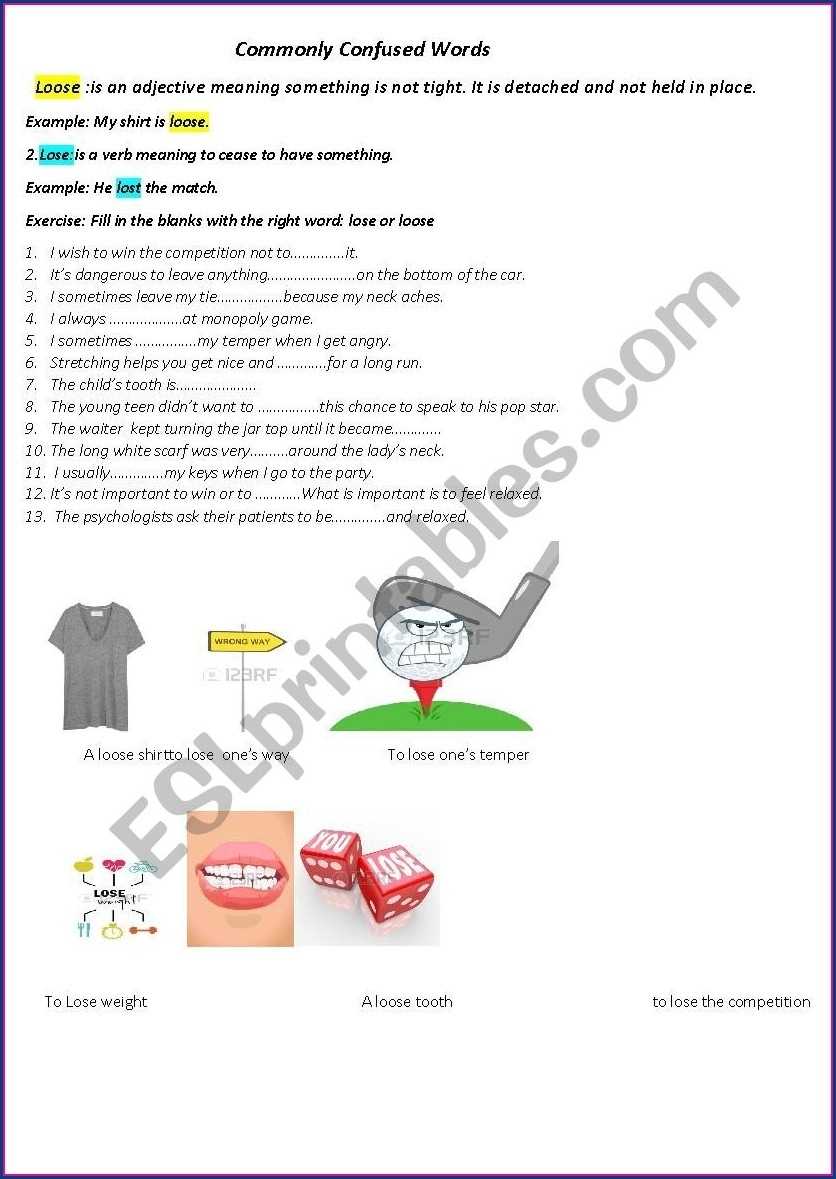
Visuals can be a great asset to teaching students about commonly confused words. By creating a worksheet that incorporates creative visuals, teachers can help their students remember the distinctions between words more easily.
The worksheet should include a visual representation of the words in question. This can be a chart, graph, or table, depending on the number of words being compared. For each word, the worksheet should include an image that will help the student remember the proper spelling and usage. Along with this, the teacher may also include a brief definition and example sentence for each word.
In addition to visuals, the worksheet should also include practice exercises. These exercises could be fill-in-the-blank statements, multiple choice questions, or even a game. The exercises should be designed to help the student remember the correct spelling and usage of the words.
Finally, the worksheet should include a section for the student to self-reflect and evaluate their progress. This could be a written response or a simple quiz. The student should be asked to explain the differences between the words and explain why they matter. This will help them internalize the material and retain it for longer.
Overall, a worksheet that combines creative visuals with practice exercises and reflection activities can be an effective way to teach students about commonly confused words. With this type of worksheet, students can easily remember how to use the words and understand why it is important to do so.
Constructing a Comprehensive Commonly Confused Words Worksheet for Effective Learning
The ability to differentiate between commonly confused words is a crucial skill for effective communication. Incorrectly using words that are often mistaken for one another can lead to misinterpretation and confusion. This comprehensive commonly confused words worksheet is designed to help learners gain a better understanding of the distinctions between commonly confused words and to improve their usage of them.
The worksheet is divided into two columns. The first column contains pairs of commonly confused words. The second column offers an explanation of the differences between the two words.
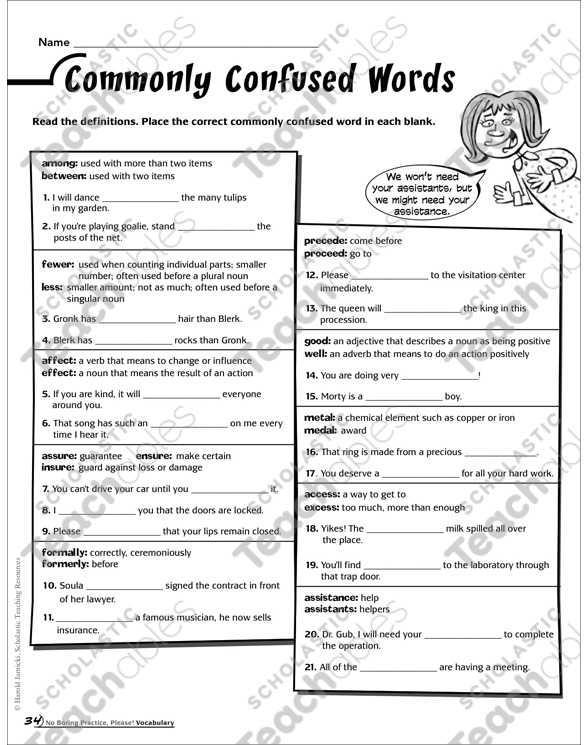
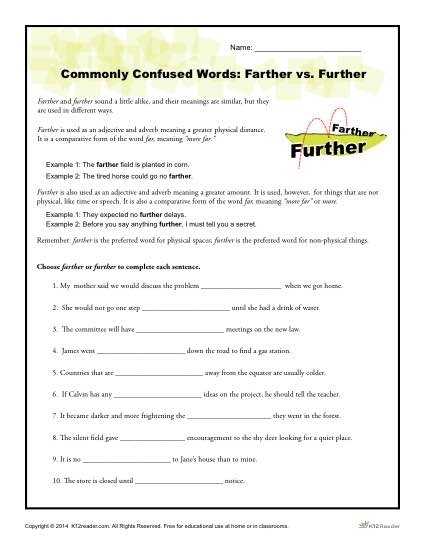
The pairs of words in the worksheet cover a wide range of commonly confused words, including those related to verbs, nouns, adjectives, adverbs, and other parts of speech. For example, the worksheet includes pairs such as accept/except, affect/effect, and fewer/less, among many others.
Each explanation provided in the second column of the worksheet contains a concise definition of the two words and explains how they are different. Furthermore, the worksheet also offers sample sentences to illustrate the correct use of the two words.
This comprehensive commonly confused words worksheet is an invaluable tool for learners looking to gain a better understanding of the distinctions between commonly confused words and improve their usage of them. By studying the pairs of words and explanations provided in the worksheet, learners will be able to effectively differentiate between commonly confused words and use them accurately in their writing.
Conclusion
The Commonly Confused Words Worksheet is an invaluable resource for anyone looking to improve their English language writing and speaking skills. By identifying commonly confused words, the worksheet makes it easier to select the correct word in a given context. Additionally, the practice activities in the worksheet can help further improve understanding and accuracy. By taking the time to work through the worksheet, individuals can improve their ability to correctly use commonly confused words.
[addtoany]
5 photos of the "Commonly Confused Words Worksheet"
Related posts of "Commonly Confused Words Worksheet"
Plate Tectonic Worksheet Answers
Explaining the Basics of Plate Tectonic Worksheet AnswersPlate tectonics is a scientific theory that explains the movement of the Earth’s lithospheric plates. It is a widely accepted scientific theory that has revolutionized the way geologists view the Earth’s surface. The theory of plate tectonics has been developed over the last several decades and is based...
Long A Sound Words Worksheet
Using Long A Sound Words Worksheets to Teach Phonemic AwarenessPhonemic awareness is an important skill for young learners as it helps to develop reading and writing skills. Teaching children to discriminate between sounds, recognize sounds in words, and manipulate sounds in words can help to build their literacy skills. Long A sound words worksheets are...
2nd Grade Vocabulary Worksheet
5 Tips for Helping Kids Learn 2nd Grade Vocabulary with Worksheets1. Read Aloud: Reading aloud is a great way to introduce your child to new vocabulary words. Have them listen carefully and make sure they understand the meaning of the words. Ask them to repeat the words and use them in a sentence. 2. Practice...
Line Plots With Fractions Worksheet
Exploring Line Plots With Fractions Worksheet: An Introduction to Graphing FractionsThis worksheet will introduce students to the concept of graphing fractions with line plots. Line plots are a type of graph that allow students to compare multiple sets of data at the same time. With line plots, students can visually identify patterns and trends in...