Exploring the Power of the United States Constitution: A Worksheet for Middle and High School Students
Introduction
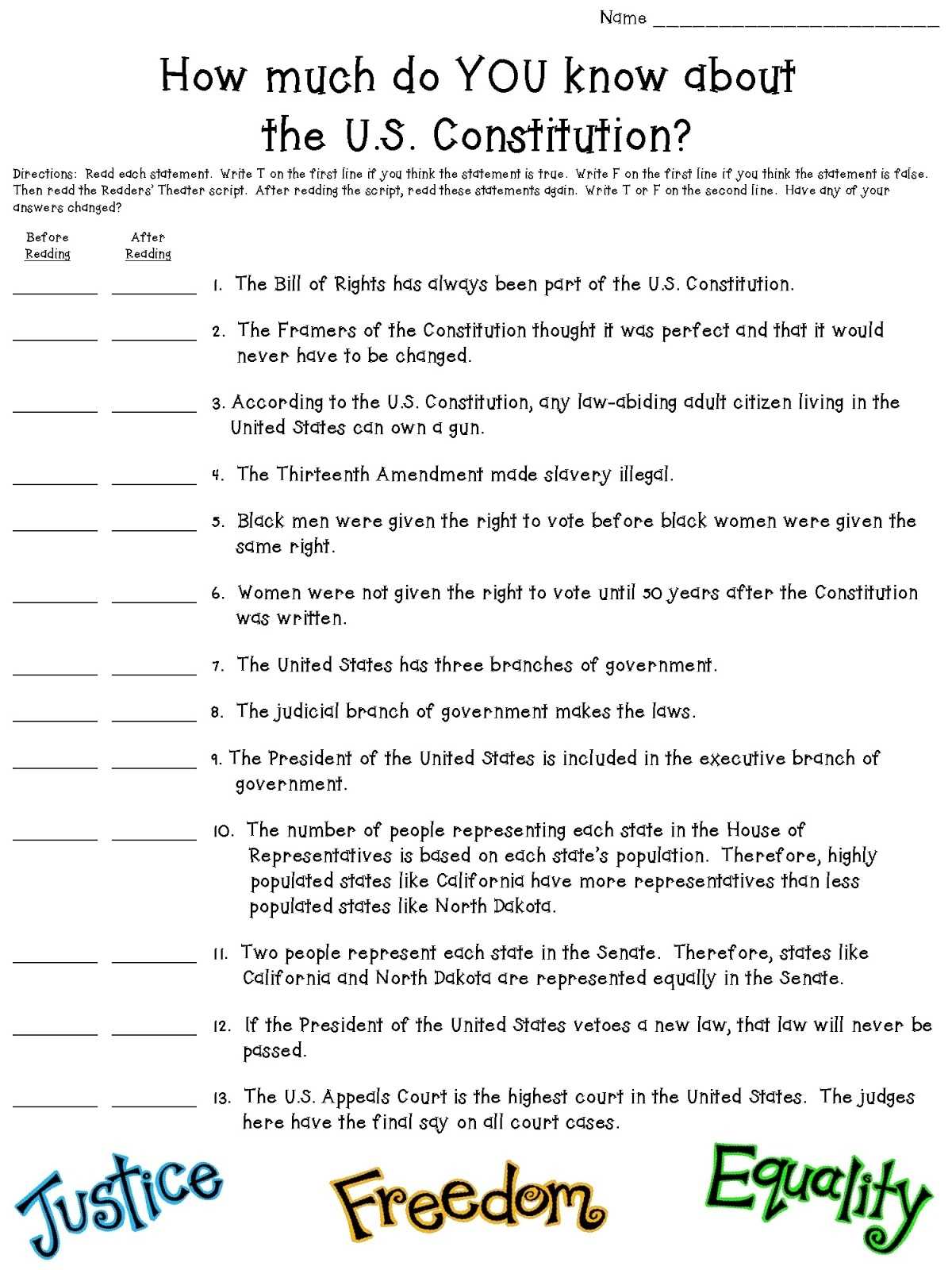
The United States Constitution is a living document that forms the basis of the entire American governmental system. It is the oldest constitution still in use today and has served as a model for many other countries around the world. The Constitution is composed of seven articles, each of which outlines the structure of the federal government and its powers. Its language is often considered to be the cornerstone of democracy and has been a fundamental source of guidance for the nation throughout its history.
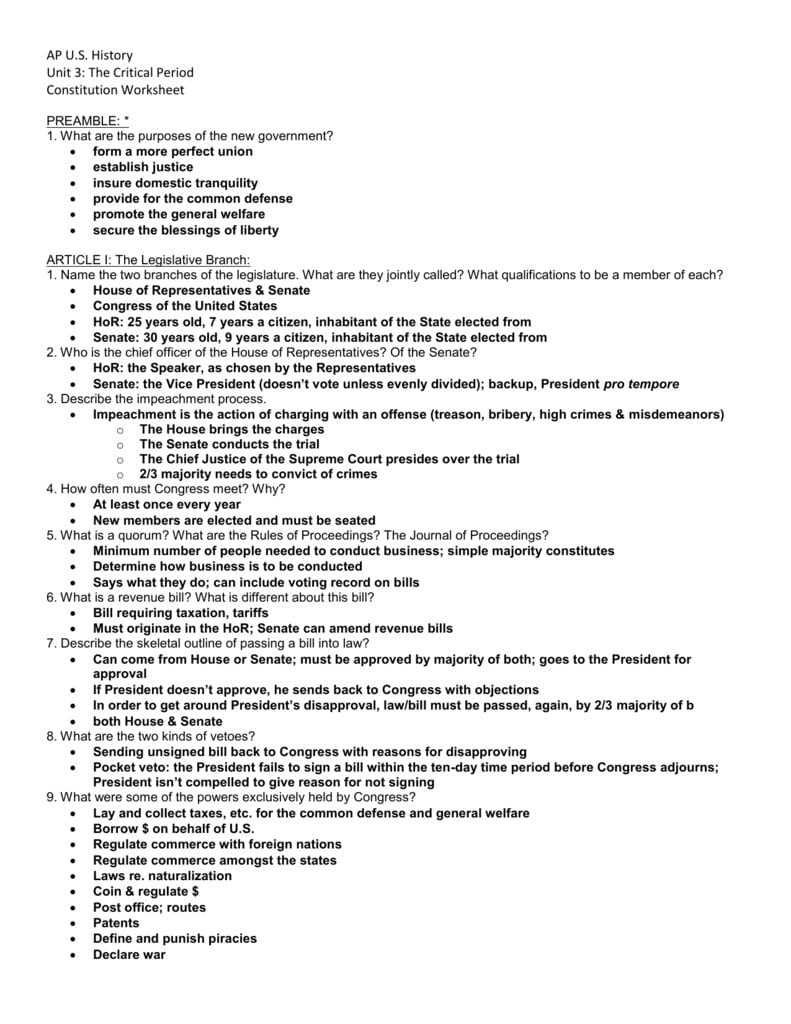
In this worksheet, students will explore the power of the United States Constitution and analyze its key principles. Through a series of activities and questions, students will gain a better understanding of the document and its importance in American government.
[toc]
Activity #1: Analyzing the Preamble
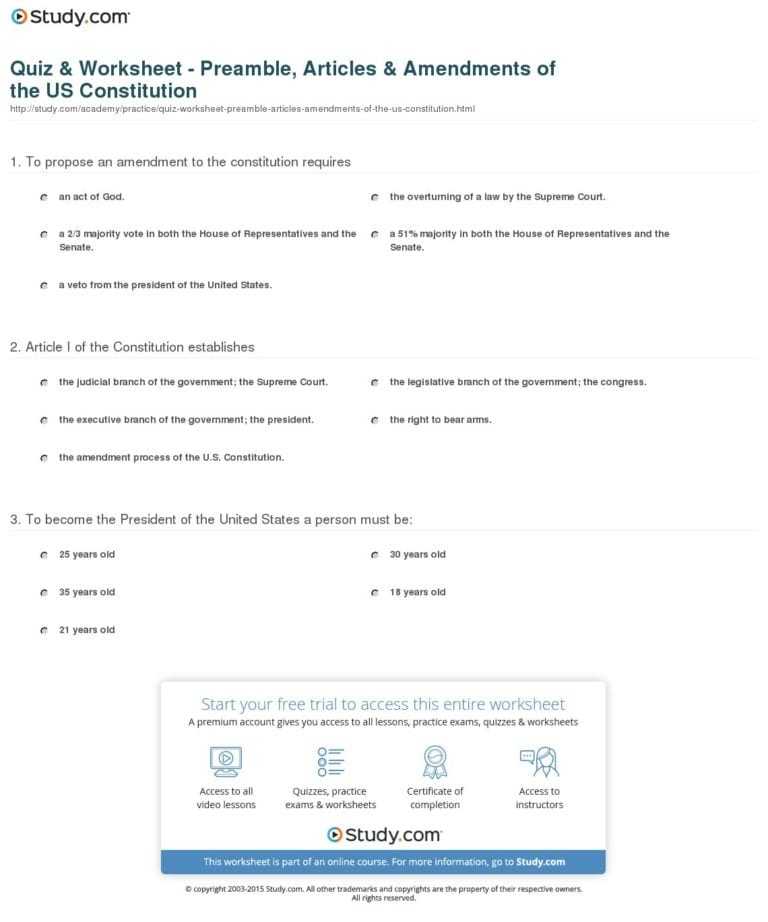
The Preamble is the first part of the United States Constitution and outlines the purpose of the document. Read the Preamble and answer the questions below:
1. What are the reasons for creating the Constitution outlined in the Preamble?
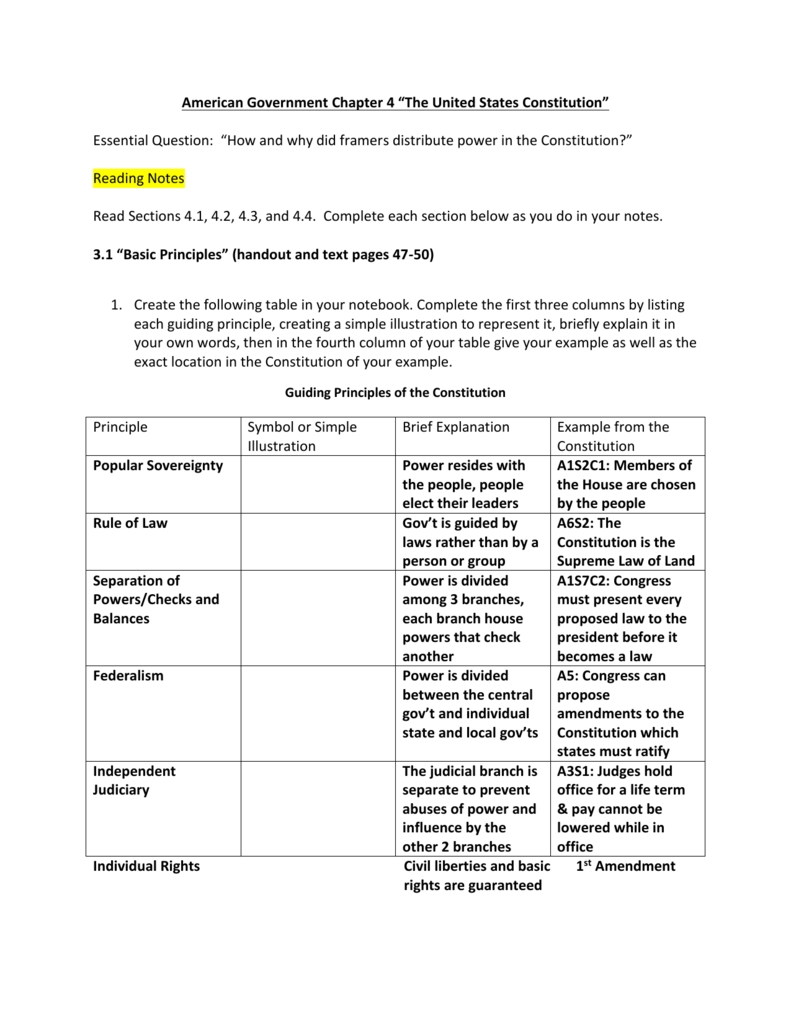
Answer: The reasons for creating the Constitution outlined in the Preamble are to form a more perfect union, establish justice, insure domestic tranquility, provide for the common defense, promote the general welfare, and secure the blessings of liberty to ourselves and our posterity.
2. What do the words “We the People” signify?
Answer: The words “We the People” signify that the Constitution is created by and for the people of the United States, and that the government derives its power from the people.
Activity #2: Exploring the Articles
The seven articles of the Constitution outline the structure of the federal government and its powers. Read through the articles and answer the questions below:
1. What are the three branches of government outlined in the Constitution?
Answer: The three branches of government outlined in the Constitution are the legislative branch, the executive branch, and the judicial branch.
2. What rights are guaranteed in the Bill of Rights?
Answer: The rights guaranteed in the Bill of Rights include freedom of speech, freedom of religion, the right to bear arms, the right to a fair trial, and protection from unreasonable search and seizure.
A Comparative Analysis of the United States Constitution and Other International Constitutions: A Worksheet
The United States Constitution is arguably one of the most significant documents in modern history. It serves as the foundation of the federal government, as well as the basis of many of the fundamental rights and freedoms that citizens of the United States enjoy. While the United States Constitution is unique in its own right, it is also possible to gain insight by comparing it to other international constitutions. This comparative analysis worksheet provides an overview of the United States Constitution and how it is distinct from other international constitutions.
The Preamble: The United States Constitution begins with the Preamble, which sets forth the purpose of the document and the goals of the framers. The Preamble is one of the most recognizable elements of the United States Constitution and is often cited in court cases. The Preamble of the United States Constitution is distinct in its brevity, stating only that the document is designed “to form a more perfect Union, establish Justice, insure domestic Tranquility, provide for the common defence, promote the general Welfare, and secure the Blessings of Liberty.” In comparison, many international constitutions have longer preambles that provide more detail about the purpose of the document, the framework of government, and the rights of citizens.
Fundamental Rights: The United States Constitution enshrines several fundamental rights for citizens, including freedom of speech, the right to bear arms, the right to a fair trial, and the right to privacy. These rights are protected by various amendments to the Constitution. In comparison, the constitutions of other countries often contain a much more detailed set of fundamental rights. For example, the Canadian Charter of Rights and Freedoms guarantees the right to life, liberty, and security of person, freedom of religion and conscience, freedom of expression, and equality rights.
Separation of Powers: The United States Constitution establishes a system of checks and balances, in which each branch of government is granted a certain set of powers and responsibilities. This system is designed to ensure that no single branch of government becomes overly powerful. Other international constitutions have similar systems in place, although the exact structure and powers of each branch may vary.
Federalism: The United States Constitution is based on the concept of federalism, which is the idea that power should be shared between the national and state governments. This system allows each state to maintain its own laws and regulations, while also allowing the federal government to pass laws that are applicable in all states. Many other countries have adopted a similar system of federalism, although the details may differ between countries.
Constitutional Supremacy: The United States Constitution is the supreme law of the land. This means that it is the ultimate authority when it comes to resolving conflicts between laws passed by the federal and state governments. Similarly, many other countries have adopted a system of constitutional supremacy, in which the constitution is the highest authority when it comes to legal matters.
In conclusion, the United States Constitution is unique in its own right, but it can be useful to compare it to other international constitutions in order to gain insight. By doing so, it is possible to gain a better understanding of the various features that make the United States Constitution distinct, as well as the similarities that it shares with other constitutions around the world.
The Impact of the United States Constitution on American Society: An Educational Worksheet
The United States Constitution is one of the most important documents in American society, as it serves as the foundation for our country’s government and laws. It is a living document that has been amended over time to reflect the changing needs of society. This educational worksheet will explore the impact the United States Constitution has had on American society.
The Constitution was adopted in 1787 and is the oldest written constitution in the world. It established a federal government with three branches—the legislative, executive, and judicial—each with its own set of responsibilities and powers. The Constitution also outlines the rights of citizens, including freedom of religion, speech, press, and assembly; the right to bear arms; and the right to a fair trial.
The Constitution’s impact on American society has been far-reaching. It has provided a framework for the nation’s laws and values, and it has established a system of checks and balances that helps to keep one branch of government from becoming too powerful. Additionally, the Constitution has ensured the civil rights of all citizens, regardless of race, gender, or religion.
The Constitution also serves as a source of national pride and unity, as it represents the history of the United States and our shared values. It is a symbol of our commitment to democracy, justice, and liberty.
In conclusion, the United States Constitution has had a profound impact on American society. It has established the framework and laws of our government, protected civil rights, and provided a source of national pride and unity. It is a living document that continues to evolve to meet the needs of our changing society.
Investigating the Amendments to the United States Constitution: A Worksheet for Students of all Ages
Introduction:
The United States Constitution is the supreme law of the land, and its amendments are an integral part of our country’s history. The amendments to the Constitution are the fundamental laws that define our rights and freedoms as citizens. In this worksheet, we will explore the amendments to the United States Constitution and the impacts they have had on our nation’s history.
Task 1:
Read through the text of the United States Constitution and identify the amendments that have been added over the years.
Task 2:
For each amendment, identify the purpose of the amendment and explain how it has impacted the United States.
Task 3:
Research the historical context in which each amendment was created. Describe the events leading up to the amendment’s creation and identify any relevant people or organizations involved in the process.
Task 4:
Discuss the impact that the amendments have had on United States history. What changes have been made in our society as a result of the amendments?
Conclusion:
The amendments to the United States Constitution are an integral part of our nation’s history. Through this worksheet, we have explored the purpose and impact of each amendment, as well as the historical context in which they were created. We have also discussed the impact that the amendments have had on United States history. By understanding the amendments, we can gain a greater appreciation of the rights and freedoms that we enjoy as citizens of the United States.
Conclusion
The United States Constitution Worksheet is an invaluable resource for those looking to learn more about the foundational document of the United States. It provides an overview of the key points and principles of the Constitution, as well as a guided discussion of the document’s implications and impact on American society. With this resource, students can gain an in-depth understanding of the document, its historical context, and its importance in today’s world.
[addtoany]
5 photos of the "United States Constitution Worksheet"
Related posts of "United States Constitution Worksheet"
Elements Of Fiction Worksheet
How to Use a Elements Of Fiction Worksheet to Help Improve Your Writing1. Read examples of fiction writing: Before you begin writing your own fiction, it's important to first become familiar with the conventions and techniques used by established authors. Reading some examples of fiction writing can help you to understand the elements of fiction...
Trigonometric Ratios Worksheet Answers
Unpacking the Basics: Exploring Trigonometric Ratios Worksheet AnswersTrigonometric Ratios are essential mathematical tools used to determine the length and angle of a triangle. These ratios are used in a variety of disciplines including engineering, physics, and astronomy. They are also an important part of basic geometry and algebraic equations. In this worksheet, we will explore...
Quadratic Functions Worksheet With Answers
Exploring Quadratic Functions: A Step-by-Step Guide to Solving Quadratic Equations with a Worksheet and Answers Introduction Quadratic functions are ubiquitous in mathematics. They are used to model many different phenomena, from the motion of a projectile to the path of a wave. They are also used to solve problems in many fields, including engineering, physics,...
Lipids Worksheet Answer Key
Exploring the Role of Lipids in Human Nutrition: A Review of the Lipids Worksheet Answer KeyThis review will explore the role of lipids in human nutrition. Lipids are a type of biomolecule that are essential to the human body and provide energy, maintain cell structure, and transport vitamins, minerals, and other important nutrients. Lipids are...